In almost every boardroom conversation I have this year, the agenda starts in the same place: costs that won't come back down, a supply chain that keeps moving under our feet, and growth that depends on people we can't hire fast enough. Technology comes up later, if at all, and usually as a question: what will actually move the numbers?

I want to share how we read this moment, the choices we've made in response, and why I believe the frontline, the place where products are made, assets are maintained and services are delivered, has become the most controllable lever on margin that an industrial company has left.

A New Operating Math

Four forces are converging at once. Any one of them would be manageable. Together they change the economics of running an operation.

COST
Inputs set by the world, not the plan
+5.0%
Expected rise in raw material and input costs over the next year; rising input costs are manufacturers' top challenge for a second straight quarter.
NAM Outlook Survey, Q3 2026
COMPLEXITY
Trade and supply chains in motion
71.8%
Manufacturers cite trade uncertainty as a top challenge, and it ranks first for companies with more than 500 employees.
NAM Outlook Survey, Q2 2026
CAPACITY
Demand returning to a shrinking
workforce
1.9M
US manufacturing jobs could go unfilled by 2033, even as manufacturers project their fastest sales and production growth in more than four years.
Deloitte & The Manufacturing Institute · NAM Q3 2026
RISK
Every stoppage costs more than it
used to
$1.4T
Lost each year to unplanned downtime by the world's 500 largest companies, about 11% of revenue.
Siemens, True Cost of Downtime 2024

Put simply: the price of everything going into the operation is rising, the people who know how to run it are scarcer, and the cost of a mistake keeps climbing. Pricing power can't absorb all of it, and headcount can't solve it.

Costs
set by the market
+
Capacity
limited by people
=
Margin
won in execution
WHERE MARGIN QUIETLY LEAKS TODAY
15–20%
of sales revenue can go to quality-related costs at many organizations: rework, scrap, deviations and failures
American Society for Quality
11%
of revenue lost to unplanned downtime at the world's 500 largest companies
Siemens, 2024
81%
of manufacturing task hours are expected to remain human-driven, even as automation and AI advance
Deloitte 2026 Manufacturing Outlook
80%
of manufacturing executives plan to put 20% or more of their improvement budgets into smart manufacturing
Deloitte 2026 Manufacturing Outlook

That third number is the one I keep coming back to. Most of the work will still be done by people. So the question for leadership is not whether to automate the frontline away. It is how to make every hour of skilled human work count for more, with less rework, fewer stoppages and less time lost to paperwork and handoffs.

The fourth number tells you the race is already on. Your competitors are funding it.

“Start with one department. Digitise two checklists. Run for four weeks.”
Atheer Industry Specialist
"Start with one department. Digitise two checklists. Run for four weeks. The outcome will be clear and instructive."
Atheer Industry Specialist

Six Oil, Gas & Energy Use Cases

01 Remote Expert Support
02 Inspection & Maintenance
03 Turnaround Orchestration
04 Safety & Regulatory Compliance
05 Predictive Maintenance & Asset Integrity
06 Knowledge Capture & Workforce Dev.
Why

Daily checklists are the highest-frequency, lowest-visibility work in OG&E. Completed on paper or a PDF form, they produce a record – not a confirmation of work done right.

What

A digitised inspection workflow: the checklist, the auditable report, and a log of any deviations + the respective corrective action – captured in sequence with a timestamp and photo at each step.

Who

One department and one crew: the person doing the work, their supervisor and the champion / stakeholder of the project (representing leadership / budget ownership).

When

Before the next drilling campaign or external audit cycle. The evidence gap is most visible there. That is the window where a pilot proves that it should be a programme.

How

Four weeks to a live pilot: digitise two existing paper checklists, train one crew of six, run four weeks of parallel execution, measure the performance against the paper baseline. The outcome will be clear and instructive.

Platform
Category
Best For
Starting Price
Free Plan
Atheer

Work execution platform

Complex, regulated industrial execution (oil & gas, life sciences, automotive)

Custom quote only

No

Augmentir

AI connected worker platform

Manufacturing plants running continuous-improvement programs

Custom quote only

No

Tulip

Composable frontline ops / MES

Manufacturers who want to build custom apps and not just use presets

From $20/interface/month

No

Poka

Connected worker platform

Enterprise manufacturers focused on training and daily management

Custom quote only

No

TeamViewer Frontline

Industrial AR platform

Warehouse/logistics picking and AR-guided remote assistance

Custom quote only

No

MaintainX

CMMS

Maintenance teams wanting a fast, mobile-first rollout

Free, paid tiers from $20/user/month

Yes

Technology matters here only to the extent it moves these lines. AI is the means, not the message. The test is whether it shows up in the P&L, not in a pilot report.

Why We Built Industry Accelerators

For years, the answer to frontline transformation has been a flexible platform and a long services project. Flexibility is valuable, but a blank platform means every customer starts at day zero, rebuilding the same roles, workflows and checks their peers have already built. In this environment, time to value is itself a financial variable: every quarter spent configuring is a quarter of margin not recovered.

STARTING FROM A BLANK PLATFORM
Quarters of configuration before value
Generic tools layered on top
Controls designed after the pilot
Cost discovered at the invoice
STARTING FROM AN INDUSTRY ACCELERATOR
Prebuilt for the industry, live in days
Agents specialized by role and standard
A named approver on every consequential step
Cost per run visible before you install

An Industry Accelerator incorporates what we've learned in an industry into a ready-to-run blueprint: the roles, the workflows, the apps and the governed AI agents, all on the same Atheer platform. Your SOPs and approval chains sit on top. You tune it to your operation rather than build it from scratch.

The agents come from the AiR Agent Library: eleven roles in five families that mirror how work actually flows, from taking it in, to getting it done, checking it, learning from it and connecting it to your systems of record. Each agent is specialized for its industry and standard, shows what it costs per run, and names who signs off. That last point matters to a CFO as much as to a plant manager: the economics and the accountability are visible before anything goes live.

What We Believe

1
Operations is Now Margin Strategy
When pricing and inputs are constrained, the most durable margin gains come from execution: doing the work right the first time, on every shift, at every site.
2
Industry Context Compounds
A system that already knows API Std 53 or 21 CFR 211, your equipment and your sign-off chain reaches value faster, and every improvement carries to the next site.
3
Accountability is What Lets You Scale
People stay in charge of consequential decisions, every action is recorded, and costs are known up front. That's what turns a promising pilot into an operating standard a board can trust.

Where We're Starting, and Why

We chose to start where a missed step costs the most and the standards are best defined: energy and life sciences. In both, a deviation, a stoppage or an audit finding carries real financial and regulatory consequences, so the payoff from getting execution right shows up fast.
Oil, Gas & Energy Accelerator
Available Now
Pharma & Life Sciences Accelerator
Available Now
Automotive Accelerator
Available Q1 2027
Manufacturing Accelerator
Available Q1 2027
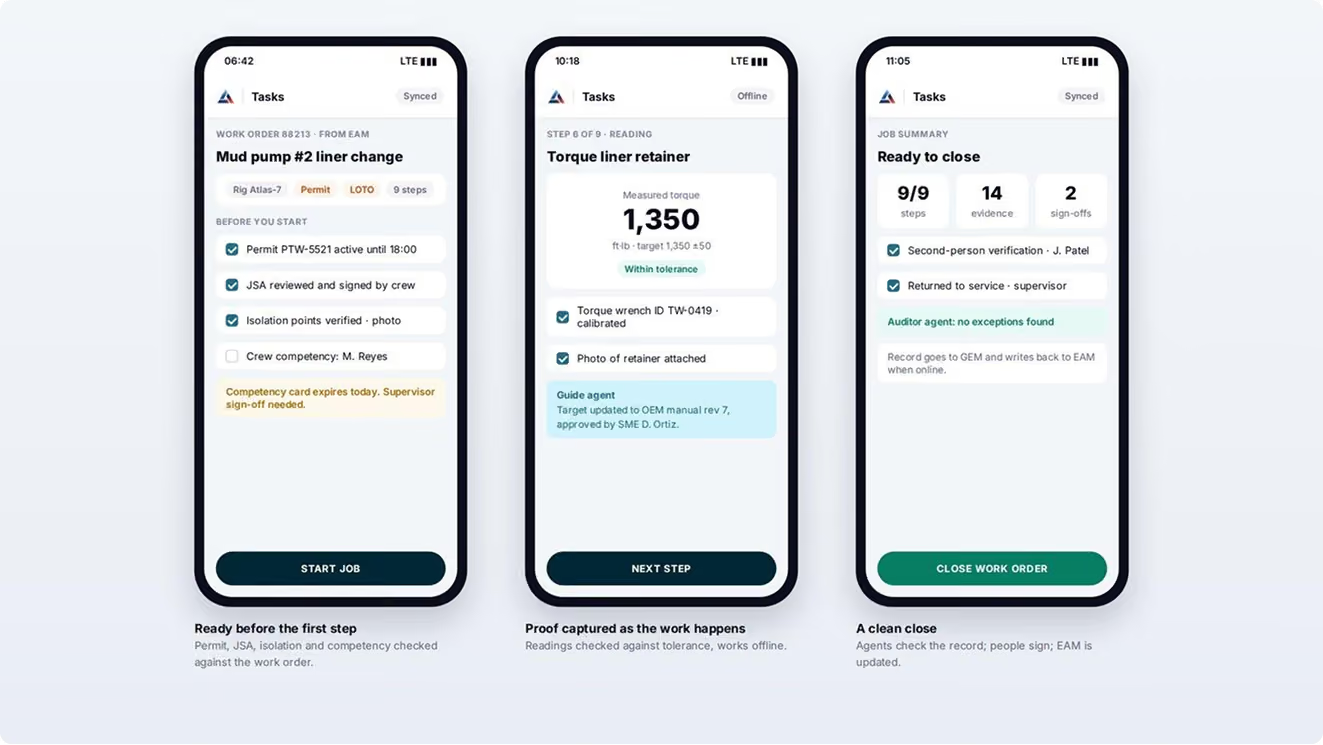
A guided OG&E job in the field, with the permit, readings and proof captured as the work happens. Concept view with illustrative data.

We're building the next phase alongside global enterprise design partners in pharma, energy and automotive. Their operations are shaping what ships, and dates remain directional as we build with them.

Five Questions to Explore with Your Leadership Team

Whether or not you work with us, these are the questions I'd put on the next operating review.

1
What does poor quality cost us as a share of revenue?
Most companies don't know the full number. Rework, deviations and repeat visits rarely sit on one line.
2
How much of our capacity depends on people retiring in the next five years?
If expertise lives in a few heads, so does your growth.
3
What does an hour of unplanned stoppage cost at our critical sites?
Then ask how many of those hours start with a missed or late step.
4
How many quarters until a new initiative pays back?
If the answer is measured in years, the economics have already moved.
5
Who is accountable for each automated decision, and what does it cost to run?
Scale needs named ownership and costs you can forecast.

Industrial companies have always won or lost on the frontline. What's different now is how little room there is for error, and how much of the margin story is written there. Our job is to give the people doing that work the best help available, and keep them in charge of it.

I welcome your feedback, and look forward to partnering with you - let’s accelerate your business, together, in a governed, controlled and cost-effective way.

Swaroop

Sources. NAM, Q3 2026 Manufacturers' Outlook Survey (Sept 15, 2026). NAM, Q2 2026 Manufacturers' Outlook Survey. Deloitte and The Manufacturing Institute, "Manufacturers need as many as 3.8 million new employees by 2033." Siemens, "The True Cost of Downtime 2024." American Society for Quality, "Cost of Quality." Deloitte, 2026 Manufacturing Industry Outlook. Product image is a concept view with illustrative data. Roadmap dates are directional and not commitments.
snandula@atheerair.com

In almost every boardroom conversation I have this year, the agenda starts in the same place: costs that won't come back down, a supply chain that keeps moving under our feet, and growth that depends on people we can't hire fast enough. Technology comes up later, if at all, and usually as a question: what will actually move the numbers?

I want to share how we read this moment, the choices we've made in response, and why I believe the frontline, the place where products are made, assets are maintained and services are delivered, has become the most controllable lever on margin that an industrial company has left.

A New Operating Math

Four forces are converging at once. Any one of them would be manageable. Together they change the economics of running an operation.

COST
Inputs set by the world, not the plan
+5.0%
Expected rise in raw material and input costs over the next year; rising input costs are manufacturers' top challenge for a second straight quarter.
NAM Outlook Survey, Q3 2026
COMPLEXITY
Trade and supply chains in motion
71.8%
Manufacturers cite trade uncertainty as a top challenge, and it ranks first for companies with more than 500 employees.
NAM Outlook Survey, Q2 2026
CAPACITY
Demand returning to a shrinking
workforce
1.9M
US manufacturing jobs could go unfilled by 2033, even as manufacturers project their fastest sales and production growth in more than four years.
Deloitte & The Manufacturing Institute · NAM Q3 2026
RISK
Every stoppage costs more than it
used to
$1.4T
Lost each year to unplanned downtime by the world's 500 largest companies, about 11% of revenue.
Siemens, True Cost of Downtime 2024

Put simply: the price of everything going into the operation is rising, the people who know how to run it are scarcer, and the cost of a mistake keeps climbing. Pricing power can't absorb all of it, and headcount can't solve it.

Costs
set by the market
+
Capacity
limited by people
=
Margin
won in execution
WHERE MARGIN QUIETLY LEAKS TODAY
15–20%
of sales revenue can go to quality-related costs at many organizations: rework, scrap, deviations and failures
American Society for Quality
11%
of revenue lost to unplanned downtime at the world's 500 largest companies
Siemens, 2024
81%
of manufacturing task hours are expected to remain human-driven, even as automation and AI advance
Deloitte 2026 Manufacturing Outlook
80%
of manufacturing executives plan to put 20% or more of their improvement budgets into smart manufacturing
Deloitte 2026 Manufacturing Outlook

That third number is the one I keep coming back to. Most of the work will still be done by people. So the question for leadership is not whether to automate the frontline away. It is how to make every hour of skilled human work count for more, with less rework, fewer stoppages and less time lost to paperwork and handoffs.

The fourth number tells you the race is already on. Your competitors are funding it.

When the cost of inputs is set by the world, the margin you still control is how well the work gets done.
Swaroop Kolli
Chief Executive Officer, Atheer

The Four levers, Seen From The Frontline

Every CEO is working the same four levers. What's changed is how much of each one now lives at the point of work.

LEVER
WHERE IT LEAKS ON THE FRONTLINE
WHAT CHANGES
MEASURED AS
Cost
OPEX

Rework, re-keyed data, repeat visits, experts pulled onto routine checks

Agents draft, check and record; people spend time on judgment

Rework hours · cost per job

Margin
QUALITY

Deviations found late, evidence missing at audit, drift from the standard

Every step guided and checked against the standard as it happens

First-time-right · deviation rate

Revenue
CAPACITY

Throughput capped by the few people who know how; slow ramps on new lines and sites

Expertise captured once and delivered to every crew, on every shift

Jobs per technician · time to ramp

Risk
COMPLIANCE · SAFETY

Unplanned stoppages, missed steps, approvals no one can trace

A named approver on every consequential step and a full record of each action

Audit findings · unplanned downtime

Technology matters here only to the extent it moves these lines. AI is the means, not the message. The test is whether it shows up in the P&L, not in a pilot report.

Why We Built Industry Accelerators

For years, the answer to frontline transformation has been a flexible platform and a long services project. Flexibility is valuable, but a blank platform means every customer starts at day zero, rebuilding the same roles, workflows and checks their peers have already built. In this environment, time to value is itself a financial variable: every quarter spent configuring is a quarter of margin not recovered.

STARTING FROM A BLANK PLATFORM
Quarters of configuration before value
Generic tools layered on top
Controls designed after the pilot
Cost discovered at the invoice
STARTING FROM AN INDUSTRY ACCELERATOR
Prebuilt for the industry, live in days
Agents specialized by role and standard
A named approver on every consequential step
Cost per run visible before you install

An Industry Accelerator incorporates what we've learned in an industry into a ready-to-run blueprint: the roles, the workflows, the apps and the governed AI agents, all on the same Atheer platform. Your SOPs and approval chains sit on top. You tune it to your operation rather than build it from scratch.

The agents come from the AiR Agent Library: eleven roles in five families that mirror how work actually flows, from taking it in, to getting it done, checking it, learning from it and connecting it to your systems of record. Each agent is specialized for its industry and standard, shows what it costs per run, and names who signs off. That last point matters to a CFO as much as to a plant manager: the economics and the accountability are visible before anything goes live.

What We Believe

1
Operations is Now Margin Strategy
When pricing and inputs are constrained, the most durable margin gains come from execution: doing the work right the first time, on every shift, at every site.
2
Industry Context Compounds
A system that already knows API Std 53 or 21 CFR 211, your equipment and your sign-off chain reaches value faster, and every improvement carries to the next site.
3
Accountability is What Lets You Scale
People stay in charge of consequential decisions, every action is recorded, and costs are known up front. That's what turns a promising pilot into an operating standard a board can trust.

Where We're Starting, and Why

We chose to start where a missed step costs the most and the standards are best defined: energy and life sciences. In both, a deviation, a stoppage or an audit finding carries real financial and regulatory consequences, so the payoff from getting execution right shows up fast.

Oil, Gas & Energy Accelerator
Available Now
Pharma & Life Sciences Accelerator
Available Now
Automotive Accelerator
Available Q1 2027
Manufacturing Accelerator
Available Q1 2027
A guided OG&E job in the field, with the permit, readings and proof captured as the work happens. Concept view with illustrative data.

We're building the next phase alongside global enterprise design partners in pharma, energy and automotive. Their operations are shaping what ships, and dates remain directional as we build with them.

Five Questions to Explore with Your Leadership Team

Whether or not you work with us, these are the questions I'd put on the next operating review.

1
What does poor quality cost us as a share of revenue?
Most companies don't know the full number. Rework, deviations and repeat visits rarely sit on one line.
2
How much of our capacity depends on people retiring in the next five years?
If expertise lives in a few heads, so does your growth.
3
What does an hour of unplanned stoppage cost at our critical sites?
Then ask how many of those hours start with a missed or late step.
4
How many quarters until a new initiative pays back?
If the answer is measured in years, the economics have already moved.
5
Who is accountable for each automated decision, and what does it cost to run?
Scale needs named ownership and costs you can forecast.

Industrial companies have always won or lost on the frontline. What's different now is how little room there is for error, and how much of the margin story is written there. Our job is to give the people doing that work the best help available, and keep them in charge of it.

I welcome your feedback, and look forward to partnering with you - let’s accelerate your business, together, in a governed, controlled and cost-effective way.

Swaroop

Sources. NAM, Q3 2026 Manufacturers' Outlook Survey (Sept 15, 2026). NAM, Q2 2026 Manufacturers' Outlook Survey. Deloitte and The Manufacturing Institute, "Manufacturers need as many as 3.8 million new employees by 2033." Siemens, "The True Cost of Downtime 2024." American Society for Quality, "Cost of Quality." Deloitte, 2026 Manufacturing Industry Outlook. Product image is a concept view with illustrative data. Roadmap dates are directional and not commitments.